

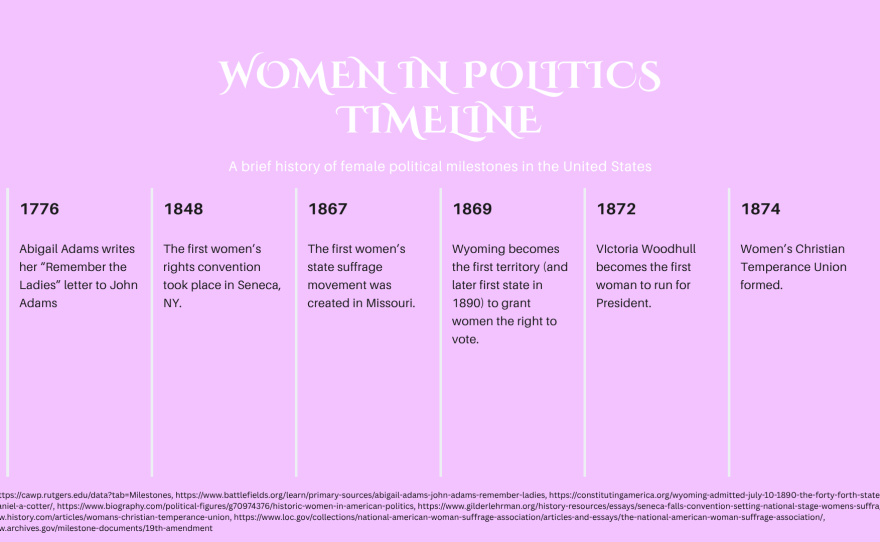
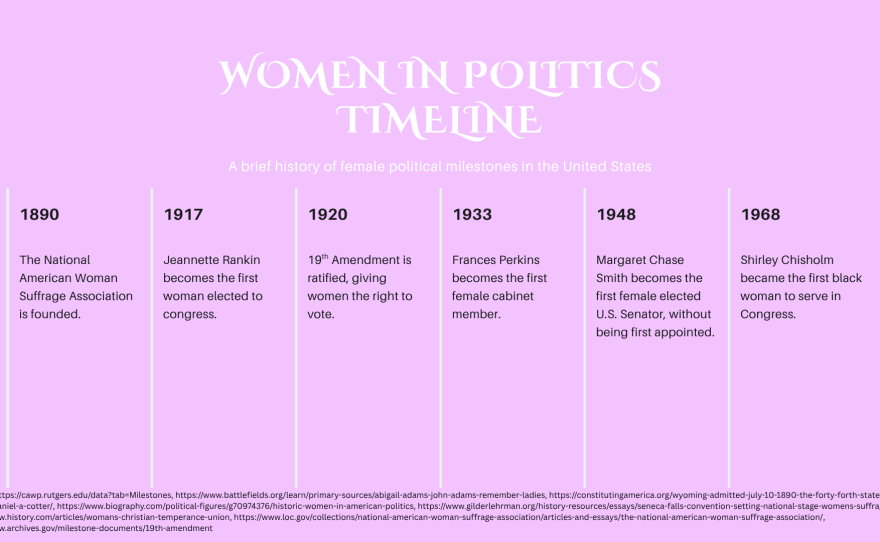
Before the right to vote was even granted, women were making advances in the arena of politics. From Abigail Adams, reminding her husband, John Adams, to “Remember the Ladies,” to the 19th Amendment being ratified in 1920, women have continued to become more involved in politics and even began running for offices themselves.
In Missouri, the state women’s suffrage movement began in 1867, and according to SEMO professor of history and anthropology, Dr. Courtney Kisat, it played a key role in the fight for women to vote.
“I think most historians look at suffrage as the beginning of women’s political participation, the movement for suffrage and in Missouri that started right after the Civil War,” Kisat said. “So, Missouri has the first state suffrage group. This woman, Virginia Minor, set it up, and then from there, Missouri’s suffrage pretty much follows the National suffrage timeline.”
Through decades of fighting for the right to vote, states began to allow women to vote, which ultimately led to the ratification of the 19th Amendment.
“It’s not until 1920 that finally the 19th Amendment is ratified and allows women’s suffrage,” Kisat said. “And women in Missouri played a key role in all of that.”

In the 106 years since women won the right to vote, they continue to be involved in politics, making an impact in their communities. In Southeast Missouri, many organizations continue to promote a female voice in politics.
Southeast Missouri is known for being a deeply Republican area, with 74.7% voting for President Donald Trump in the 2024 election, according to Ballotpedia.
The SEMO Federated Republican Women was founded by Debbie Colyott, who is the current MO 8th District Federated Republican Women’s president and works in the official office of District 8 Congressman Jason Smith.
“We had a Republican Women’s Club, but it had folded and these Federated Republican Women are statewide, district, club level and federal. So we wanted to have that, I guess you would say, structure and to make a difference to show that women can make a difference in politics,” Colyott said. “We have a lot of Republican women in this area who are very strong women and we thought could really make that difference and make a difference for our country.”
Some of these women grew up in politics and carried these beliefs into their adult lives. SEMO Federated Republican Women's president Jennifer Gast said that her upbringing influenced her involvement in politics.
“I’ve always loved politics. I was raised in a family that was very much involved in politics. I remember when I was in college there at SEMO, I was vice president of the College Republicans,” Gast said. “I was able to pick Dan Quayle up at the airport, that was kind of a really cool thing for me to do. I remember going to New York and a group of us, we were on the Rush Limbaugh show, so that was cool.”
For SEMO Federated Republican Women’s social media and marketing manager, Jess Weiss, her interest in politics came much later.
“My mom was very big in politics forever and I hated it,” Weiss said. “Absolutely hated it. I think my biggest issue was I did not ever agree with all of one party and all the other party. I agreed with certain things, but as I got deeper in my faith and felt a deeper understanding, I respected for the Republican Party and just more of those conservative values that I feel like are being misled, kind of watered down, which the world has made that seem okay.”
Weiss says that she hopes her involvement in politics will have an impact on the younger generation.
“What I see in the public schools is women, aunts, moms, sisters, big sisters who are raising these babies, these kids don’t have a lot of strong men around them, so we have to be the strong influence that they are seeing as they’re growing up and just providing them the understanding of ‘Hey this is right, this is wrong’,” Weiss said. “I think my goal, politics-wise, or anything like that, is to make a better world for everybody, right?”
Gast echoed that women should have a strong voice and opinions.
“Women should have a strong voice in everything that we do. For so much of the history books that our kids read about, women did not have a voice, they didn’t have the right to vote. There obviously are areas here in the country where women still don’t have a voice and so it’s important that all women have a voice in everything that we do,” Gast said.
While conservative values hold strong in Southeast Missouri, other political movements have garnered some attention. Indivisible SEMO is a progressive and non-partisan organization, according to their website, that recently hosted a No Kings Protest on March 28.
Member of the Indivisible SEMO leadership team, Amy Nantz, said that these protests were designed to showcase the community’s frustration with actions taken by the Trump administration.
“There’s checks and balances for a reason and those are to keep things like that from happening,” Nantz said. “Unfortunately, right now, those are being stepped on pretty hard. I feel like your basic steps to get from A to B are just being gone over. So a lot of people are really upset about that. They’re upset that they don’t get a chance to voice their concerns before it's done.”
While there were young people participating in the No King Protest, Nantz said that it will take more young women being involved to make an impactful change.
“It’s going to take younger women, because a lot of us, we’re willing to do it. We’re out there every day doing whatever we can.” Nantz said. “We’re talking to people. We’re stopping people, we’re calling people on the phone. We’re making 100 phone calls a day to different politicians and putting our voices out there, but they’re hearing just a lot of older women that have the time to do that.”
Former president of the Perry County Democrats, Kelly McKerrow, became active in politics during the Vietnam War while she was in nursing school and later during the pro-choice movement. She believes that women continue to be underrepresented and their involvement is important.
“We’re underrepresented in politics, and so we need to make sure that people see our faces, especially younger voters, and younger women, younger girls,” McKerrow said.
Vice president of the Perry County Democratic Committee Joyce Wright also got involved with politics due to a war, which helped her pay attention to what was going on in her area.
“My parents, my father always worked at election polls,” Wright said. “I’ve been working at election polls since the late 1990s here in St. Louis, and when we moved to Perry County, I signed up down there and I saw, I guess one big thing, was the Iraq War that got me to pay attention to what was going on and just being involved and seeing our legislators.”
However, for many women, raising their voices on political issues can be difficult. McKerrow recognized the challenge that women face in speaking out.
“Perry County is ruby red, has been for a long time, lots of MAGA,” McKerrow said. “People, mostly MAGA, although there’s an undercurrent that you can sense, but people, mostly women, don’t want to speak out because it jeopardizes their job, it jeopardizes their social standing and I get that. I get that now I’m old enough now not to reap any of those repercussions I did when I was working, but I don’t care, I can just say what I want, which is liberating actually.”
Some women have taken political advocacy to the next step, running for political office. According to Neilsburg, women account for 50.5% of the US population, yet the Center for American Women and Politics reports that women only account for 33.6% of elected officials in state legislatures. In MO, women only account for 28.9%.
MO District 144 Republican State Representative candidate Chris Dinkins previously served three terms and noted the difficulties of representing a rural district.
“Rural communities, they’re more close-knit, but versus the urban areas, when you’re in the house, you’re always fighting for the rural communities, because they have so much less people,” Dinkins said. “Even though there’s several more counties that are rural than what there are urban, the urban areas has a vast majority more people than what they do in rural communities. So it seems like you’re always having to fight.”
While it can be challenging to fight for the interests of a rural district, Dinkins said that it is also difficult to get anything done as a woman.
“We need to have the perspective of men, women, rural, urban, all aspects of it, in order to make the best legislation,” Dinkins said. “Don’t get me wrong, that there’s 163 representatives, the vast majority of them are men, and it is harder for one to get something done in that building than what it is for me, it just is, and it’s harder to get on leadership. It’s harder to get your bills passed.”
MO District 146 Democratic State Representative candidate Mary Harriet Talbut has also faced challenges when being involved in politics.
“They’ll comment on how I dress, they’ll comment on my shoes, and they will never have that comment for a man,” Talbut said. “The double standard is something I have dealt with my whole life, and at this point, I’ve thought about it, and if they say something, there’s a lot of different comebacks that I have, mostly one of which is, 'How old are you?’ Why are you telling me that? What was the reason that you asked me that question?”
Despite these comments, Talbut still believes it is important for women to be involved in politics.
“We’re 50% of the population, we may be talked over. We may be mansplained more times than not, but it doesn’t mean that we aren’t important, that we don’t have something to say.” Talbut said.
While women run for office across the nation, a major topic of conversation in recent years has been the possibility of a female president. Hillary Clinton came close in 2016 and Kamala Harris in 2024, both losing to Trump.
Kisat hopes that one day, with the election of a female president, women’s accomplishments will not be judged by their gender.
“Would just electing a woman as president make a big, huge difference for all women, or is it more the person who’s in the presidency?” Kisat said. “That is what frustrates me when I see that we’ve never had a woman leader. I wish people could be judged by their deeds and actions and not on their gender. I hope someday we can come past this, like a woman can’t do that purely for being a woman, or this is something a man’s always done, it’d be nice to get to a society where we can all just be judged based on our own selves and not anything else.”
These accomplishments and the impact they make continue to the next generation of women who will become politically involved. Becoming politically active doesn’t have to be hard, Nantz said, all you have to do is take the first step.
“I think the main thing is just to take that first little step, and it doesn’t take much to see what it’s about,” Nantz said. “See if there’s something that interests you, like a certain area, are you really passionate about health care in rural communities? Are you really passionate about the role of women’s rights in states?”
With these passions, Colyott says, it is important to make up your own mind. “Be involved. Be active. Be proactive.” Colyott said. “Don’t listen to the media. Go find out for yourselves. You’re smart women, go find out for yourselves the real answers.”
Weiss included that the importance of listening to other perspectives, not just focusing on your own opinions, is what makes a good leader.
“I feel like being a leader does not always have to mean being the loudest or the smartest, I don’t want to be the loudest,” Weiss said. “I do not want to be the smartest in the room because I want to learn from everyone else in there and probably, if I’m too loud, I’m missing something that I needed to hear. So I’m gonna listen. I’m gonna watch. I’m gonna see what I can do better the next time.”
The Southeast Arrow, a student-run news organization at Southeast Missouri State University originally published this story.
